
Why a registered electrician matters for grid-tied solar
Grid Connected
Grid-tied solar lives in your consumer unit as much as on your roof. Here is why that should be an electrician’s job.
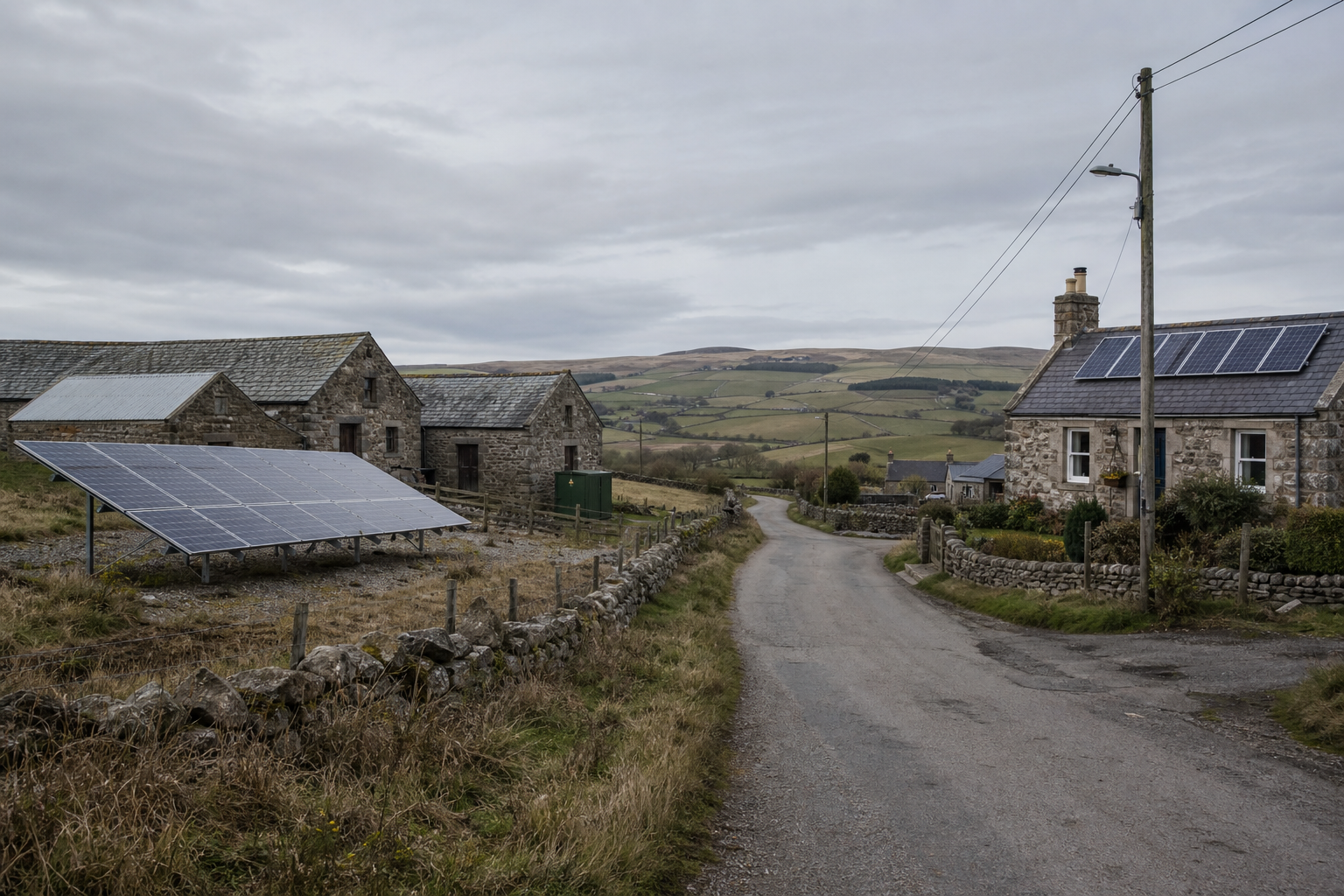
Off-grid and grid-connected solar get talked about as if they were trims of the same car. They are not. One is a power station you own. The other is a bill-reduction machine that still leans on the public network. Austen’s Energy builds both in Scotland. The expensive mistake is buying the off-grid kit for a house that already has a perfectly good supply — or trying to “go independent” on a battery that was sized for cheap-rate shifting.
If the DNO already serves the property, grid-connected solar is usually the right first design. Panels, hybrid inverter, battery, export as allowed. When the sky is a lid in January, the grid is still there. Austen is a registered electrician, so the connection, G98/G99 path and consumer unit are part of the same job — not a subcontracted afterthought.
This is the default for most homes around Aberdeen and for many farms that already pay for a three-phase supply they would be foolish to abandon.
Off-grid power is for sites where bringing or upgrading mains is slower, dearer or less reliable than building a proper island system. Think remote cottages, some highland and island jobs, and farms that already live on a generator. You need more battery, a generator strategy, and an installer who has actually run a house through a Scottish winter on that kit.
We have done this in North Aberdeenshire — see the organic farm solar case study and our other case studies. Those jobs are not a cheaper version of grid-tied. They are a different product.
A steading can be grid-tied on the farmhouse and effectively islanded in a workshop. Three-phase batteries, as in our Inverness-shire upgrade work, are sometimes about farm loads rather than lifestyle independence. Tell us what must never go dark: calving cameras, freeze rooms, or just the kettle. The answer changes the drawing.
Agricultural clients should also read Power up your farm. Domestic clients comparing independence with bill-cutting should start with home battery storage in Scotland.
If you would still want a mains fuse after the solar is fitted, you want grid-connected. If the mains is a liability or does not exist, you want off-grid. If you are trying to disappear from the bill while keeping the fuse “just in case”, that is still grid-tied plus a larger battery — and we should talk about backup, not about cutting the incoming cable.
Send location, a photo of the supply (or the lack of one), and what you cannot afford to lose. We will say which side of the line you are on before anyone prices panels. Enquire here.
Some sites want grid-tied solar with a backup island mode for outages. That is still a grid-connected system with extra switching and usually more battery than a pure bill-cut. It is not off-grid, and it should not be priced as off-grid. If a salesperson uses the words interchangeably, ask them which fuse they intend to pull. We would rather have that conversation on the enquiry form than in a field in January.
Three-phase farms can also split: house on the grid, a remote shed on its own array. That is two systems, two designs, sometimes two batteries. Say so early. It changes labour more than it changes the brochure.
Austen’s Energy designs, supplies and installs solar and battery systems for homes, farms and businesses across Aberdeenshire and Scotland. Austen is a registered electrician, so we can specify grid-connected as well as off-grid work. Send an enquiry and we will tell you honestly what is worth fitting.
Take control of your energy future! Imagine generating clean, reliable power for your home with an off-grid solar system. Austen's Energy can help you explore the possibilities.